Lost Your Patent Due to Non-Payment? How to Restore a Lapsed Patent in India

A missed renewal deadline may put a patent at risk, but timely legal action can provide a path to restoration
Imagine spending years developing an innovative technology, obtaining a patent, and building a business around it, only to discover that the patent has lapsed because a renewal fee was missed. Does that mean the patent is lost forever?
Not necessarily.
Indian patent law provides a specific legal mechanism for restoring a lapsed patent in certain circumstances. If the failure to pay the renewal fee was unintentional and the patentee acts within the prescribed time, restoration may be possible under the Patents Act, 1970. However, restoration is not an automatic process; the patentee must satisfy the Controller of Patents and Designs and follow the prescribed procedure.
So, what exactly causes a patent to lapse? How long does a patentee have to seek restoration? What evidence may be required to prove that the non-payment was unintentional? And what happens to third parties who started using the invention while the patent was lapsed?
Let’s explore the legal framework, procedure, practical considerations, and recent Indian case law governing the restoration of lapsed patents in India.
When does a patent lapse?
Under the Indian patent system, renewal fees are payable periodically to maintain a granted patent. The prescribed renewal period may also be extended by up to six months subject to the applicable additional fee. If the fee remains unpaid even within the permitted extended period, the patent ceases to have effect.
It is important to distinguish lapse from expiry. A patent that has reached the end of its statutory term has expired and cannot ordinarily be revived through the restoration mechanism. Restoration under Section 60 specifically addresses cessation caused by failure to pay a renewal fee.
For example, imagine a technology company owns an Indian patent covering a commercially successful manufacturing process. Its patent-management system fails to alert the company about an annuity, and the fee is not paid even during the permitted extension period. The patent subsequently ceases to have effect. If the statutory requirements are satisfied, the company may seek restoration rather than simply treating the patent as permanently lost.
Section 60: The 18-month restoration window
Section 60 provides the statutory route for restoration. The patentee or legal representative may apply for restoration within 18 months from the date on which the patent ceased to have effect. In the case of joint ownership, one or more co-owners may apply with the Controller’s leave without necessarily joining all the others.
The application is filed in Form 15 under Rule 84. The application must explain the circumstances that caused the renewal fee to be missed. The statement must be properly verified, and the Controller can request additional evidence.
This is where restoration becomes more than a simple fee-payment exercise. A patentee should be prepared to establish, through documentary evidence where appropriate, why the non-payment occurred and why the subsequent restoration request was made promptly.
What does the Controller examine?
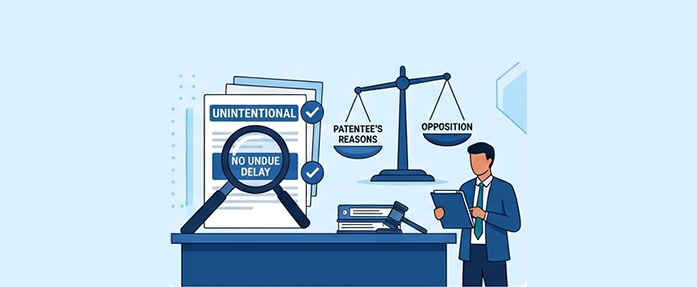
Section 61 establishes two important tests:
- The failure to pay the renewal fee was unintentional; and
- There was no undue delay in filing the restoration application.
If the Controller is prima facie satisfied, the restoration application is published. An interested person can then oppose restoration on the grounds that the failure was not unintentional or that there was undue delay.
Under Rule 84, if the Controller does not find a prima facie case, the applicant is informed and has one month to request a hearing. If the Controller is satisfied after the hearing that the failure was unintentional, the application proceeds to publication.
Following publication, a person interested in the patent may oppose the restoration by filing Form 14 within two months from the date of publication, in accordance with Rule 85. If there is no opposition, or the opposition is decided in favour of the patentee, the Controller may order restoration. The unpaid renewal fees and prescribed additional fee must then be paid within one month from the restoration order under Rule 86.
What happens during the lapse period?
Restoration does not mean that the patentee can automatically claim infringement for the entire period during which the patent was lapsed.
Section 62 provides protection to certain third-party activities undertaken during the period between cessation of the patent and publication of the application for restoration. In particular, the provision protects persons who, during this period, began in good faith to use the patented invention or took definite contractual or other steps to do so. More importantly, no infringement proceeding can be commenced or prosecuted for infringement committed during that particular period.
This safeguard is commercially significant. Suppose a third-party manufacturer checks the patent register, sees that a patent has ceased to have effect, and begins manufacturing the relevant product. If the patent is subsequently restored, the third party is not simply treated as an infringer for activities carried out during the protected intervening period.
Recent case law: Courts examining procedural fairness
Recent Delhi High Court decisions demonstrate that restoration applications are being examined in the context of the actual circumstances surrounding the missed renewal.
In Thijs, Roeland Michel Mathieu v. Assistant Controller of Patents and Designs (2024), the patent had lapsed because the renewal communication was sent to an incorrect email address. The Delhi High Court found that the applicant had provided a different email address for service and had no intention to abandon the patent. The Court therefore directed restoration upon payment of the renewal fee.
Another important decision is SPV Laboratories Pvt. Ltd. v. Controller General of Patents and Designs (2024). The applicant’s first renewal fee was missed because of an exigency in the patent attorney’s family. Although the Controller initially refused restoration because the evidence was considered insufficient, the Delhi High Court noted the applicant’s diligence, including its continued compliance with other patent-related requirements. The Court treated the lapse as a procedural failure and directed restoration, accepting the renewal fees and applicable additional fee.
These decisions illustrate an important practical point: a restoration application should be supported by a credible factual record, not merely a statement that the fee was accidentally missed.
A practical approach for patentees
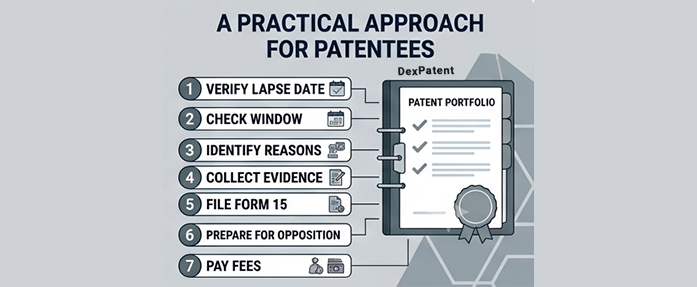
If a patent has lapsed, the patentee should immediately:
- verify the exact date on which the patent ceased to have effect;
- check whether the 18-month restoration period is still available;
- identify precisely why the renewal fee was missed;
- collect supporting evidence, such as correspondence, docketing records or relevant communications;
- file Form 15 without unnecessary delay;
- be prepared for possible opposition; and
- pay the outstanding renewal fees and applicable additional fees within the prescribed period after an order allowing restoration.
The Indian Patent Office currently lists Form 15 Application for Restoration of Patent among its official patent forms.
Conclusion
Restoration of a lapsed patent in India is a statutory remedy designed to prevent an unintended administrative or procedural failure from permanently destroying valuable patent rights. But it is not an automatic revival mechanism. The patentee must satisfy the Controller that the non-payment was unintentional, that the restoration request was made without undue delay, and that the statutory procedure has been followed.
For businesses, the lesson is straightforward: patent renewal management should be treated as a critical part of IP portfolio management. If a lapse nevertheless occurs, acting quickly and building a well-documented factual case can make the difference between losing valuable rights and successfully restoring them.















0 Comments