From Stadium to Startup: How Sports Tech Patents Are Driving Billion-Dollar Innovations
Introduction: Where Performance Meets Protection
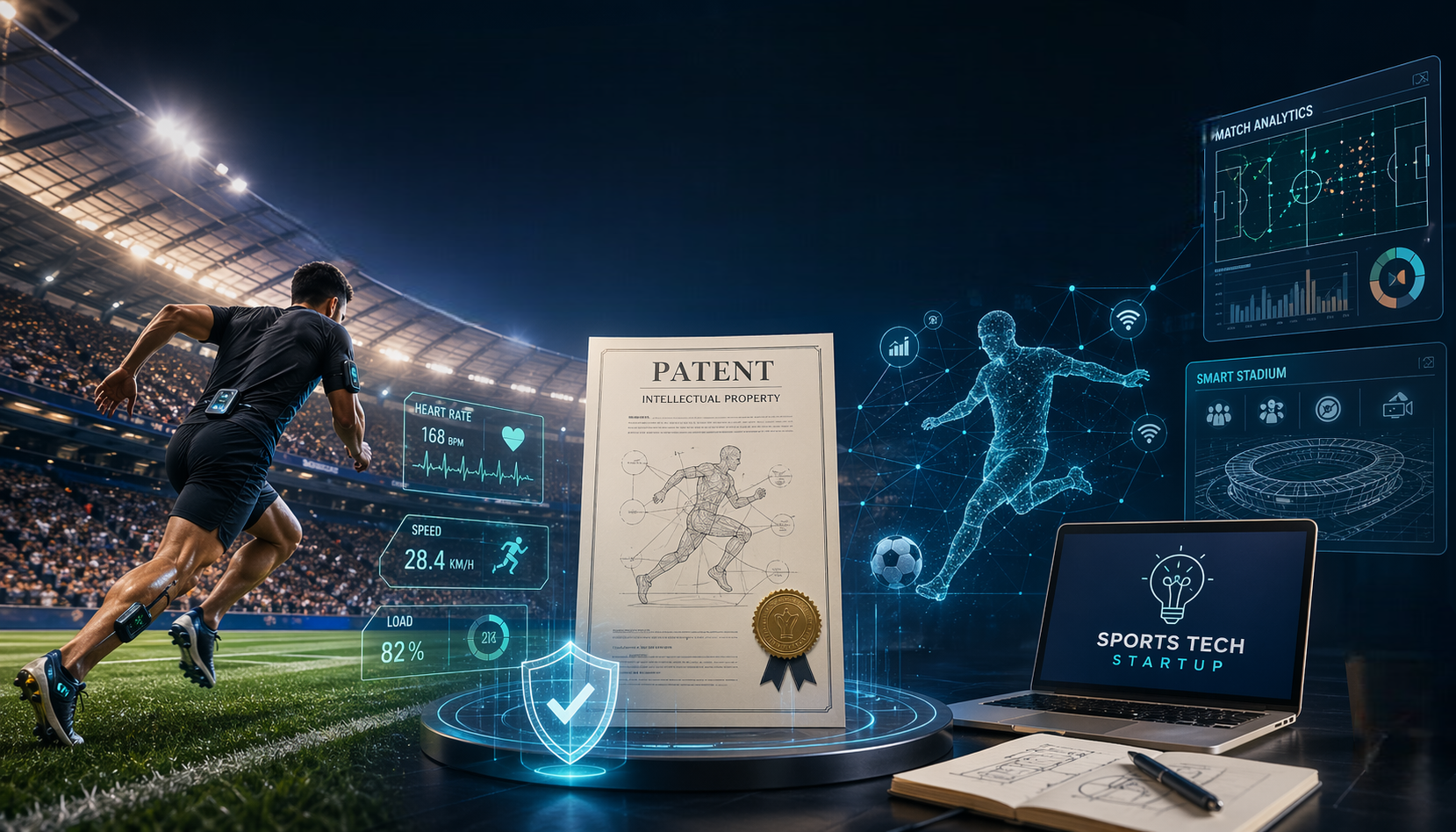
In 2026, sports innovation is no longer confined to the field, it is powered by data, driven by technology, and protected by patents. From smart wearables tracking athlete biometrics to AI-powered match analytics, sports today is no longer just about physical performance, it is deeply intertwined with technology. Behind many of these breakthroughs lies a powerful but often overlooked driver: patents.
As the World Intellectual Property Organization’s 2026 theme “IP and Sports: Ready, Set, Innovate!” highlights, intellectual property is transforming sports into a fertile ground for billion-dollar startups. But how exactly do patents enable this transformation, from stadium innovation to scalable business ventures?
In this blog, we will walk you through how patents act as the bridge between sports innovation and scalable business ventures.
The Evolution of Sports Technology Patents
Historically, sports-related patents were largely limited to equipment innovations such as improved racket designs or enhanced shoe soles. Early developments including performance footwear patents by companies such as Nike, primarily focused on material science and ergonomics.
Today, however, the scope has expanded significantly to include:
- Wearable biosensors (heart rate, oxygen levels, fatigue detection)
- Computer vision systems (player tracking, VAR technology)
- AI-driven performance analytics
- Connected stadium ecosystems (IoT)
- Fan engagement platforms (AR/VR experiences)
This evolution reflects a shift from mechanical inventions to software-enabled and data-driven innovations. As a result, it brings new legal and patentability challenges, especially in jurisdictions like India, where software-related inventions face stricter scrutiny under Section 3(k) of the Indian Patents Act.

What Makes Sports Tech Patentable?
For a sports technology invention to be patentable, it must satisfy three key criteria:
- Novelty – The invention must be new and not disclosed anywhere in the world
- Inventive Step – It must involve a non-obvious improvement over existing technology
- Industrial Applicability – It must have practical, real-world use
In sports tech, however, patentability often depends on how the invention is presented in the claims, especially for software-driven innovations.
For example, consider a startup developing a smart insole that detects gait imbalance using pressure sensors and AI:
- If the invention is claimed simply as an “algorithm for gait analysis,” it may be rejected as an abstract idea
- However, if it is claimed as a “system comprising pressure sensors embedded in an insole, configured to generate biomechanical signals processed by a defined signal-processing architecture,” it is more likely to be considered patentable
This highlights an important principle: linking software or algorithms to a specific technical system or hardware implementation significantly strengthens patentability.
Globally, many jurisdictions allow software-related inventions when they demonstrate a technical effect or technical contribution. However, in India, such inventions face stricter scrutiny under Section 3(k) of the Indian Patents Act, making careful claim drafting even more critical.
To better understand how patents shape innovation and competition in sports technology, it is useful to look at real-world examples. These case studies highlight how companies leverage patents not only to protect their inventions but also to build strong market positions and scalable business models.
Case Study 1: Wearable Tech and Data Ownership Battles
This case study highlights how patent portfolios play a critical role in competition within wearable technology ecosystems.
Companies like WHOOP and Fitbit have built massive valuation through patented wearable ecosystems.

A notable legal battle involved Fitbit and Jawbone, where disputes centered around:
- Data synchronization techniques
- Sleep tracking algorithms
- Hardware-software integration
Although not a single landmark court judgment, the litigation demonstrated how patent portfolios, not just products, determine market dominance.
Case Study 2: Hawk-Eye Technology in Cricket and Tennis
This case study highlights how integrated technologies can be protected through layered patent strategies.
The ball-tracking system developed by Hawk-Eye Innovations is widely used in sports like cricket and tennis.
From a patent perspective, its strength lies in combining multiple technologies into a single system.
Hawk-Eye’s system integrates:
- Multiple high-speed cameras
- Triangulation algorithms
- Predictive modeling
This combination is protected through a bundle of patents covering system architecture and data processing methods, making it difficult for competitors to replicate.
What began as a tool for decision-making in sports is now widely licensed to leagues and broadcasters worldwide, showing how patented technologies can generate significant revenue.
Case Study 3: Smart Stadiums and IoT Ecosystems
This case study demonstrates how patents support large-scale, data-driven infrastructure in sports environments.
Modern stadiums are becoming “smart infrastructure hubs.” Technologies include:
- Crowd flow optimization using AI
- Contactless entry systems
- Real-time concession analytics
Startups working in this space often file patents around:
- Sensor networks
- Edge computing frameworks
- Data aggregation platforms
For example, companies like IBM have patented systems related to real-time event analytics in large venues.
As sports technologies become more complex and software-driven, they also introduce new legal and patentability challenges.
Legal Nuances: The Grey Areas in Sports Tech Patenting
- Software Patentability
Globally, software-related inventions are not always patentable unless they demonstrate a technical effect or technical contribution. However, the level of scrutiny varies by jurisdiction. For instance, in India and Europe, pure software algorithms are generally not patentable unless they meet specific technical requirements.
- Data Ownership vs Patent Rights
Who owns athlete performance data?
- The athlete?
- The team?
- The tech provider?
While patents protect systems and methods, data rights often fall under contracts and data protection laws, creating a layered IP strategy.
- Standard Essential Patents (SEPs) in Sports Broadcasting
Technologies used in live broadcasting (compression, streaming protocols) may fall under SEPs, requiring licensing under FRAND (Fair, Reasonable, and Non-Discriminatory) terms.
From Patent to Billion-Dollar Startup: The Commercialization Path
A strong sports tech patent can unlock multiple monetization channels:
- Licensing Models
Instead of manufacturing, companies license patented tech to leagues and broadcasters.
- Venture Capital Attraction
Investors often evaluate:
- Patent claim breadth
- Freedom-to-operate (FTO)
- Competitive barriers
- Strategic Acquisitions
Large corporations acquire startups primarily for their IP portfolios. For example,
Google’s acquisition of Fitbit was driven significantly by its health-tech IP assets.
While patents enable monetization and investment opportunities, the journey begins with how an idea is structured and protected. The example below illustrates this process.
Practical Example: From Idea to Sports Tech Patent
Imagine you are an inventor developing a real-time injury prediction system for football players.
Step-by-step patent strategy:
- Identify Novelty – Unique sensor fusion and predictive model
- Draft Claims – Focus on system architecture, not just algorithm
- File Provisional Application – Secure early priority
- Conduct Patentability Search – Determine existing prior art
- Expand Globally – Use PCT route for international protection
If protected strategically, such a system could be licensed to:
- Professional leagues
- Sports academies
- Fitness platforms
The Role of Patent Analytics in Sports Innovation
Patent landscapes are increasingly used to:
- Identify white spaces in sports tech
- Track competitor innovation
- Guide R&D investments

For instance, analyzing filings in wearable tech can reveal trends in:
- Non-invasive biometrics
- Energy-efficient sensors
- AI-driven coaching systems
Conclusion: Innovation Wins, But Protection Sustains
Sports technology is no longer just about enhancing performance, it is about building defensible, scalable, and monetizable innovation ecosystems.
Patents play a central role in this journey:
- They transform ideas into assets
- They create barriers to entry
- They enable startups to compete globally
As we move forward in an era where data, AI, and human performance intersect, the real winners will not just be athletes on the field, but innovators who understand how to protect and commercialize their inventions effectively.
So, whether you’re an inventor, startup founder, or business leader, the message is clear:
In sports tech, innovation may start in the stadium, but its true value is unlocked through strategic patenting and commercialization.















0 Comments