Early Publication of Patent Applications in India: Is Faster Always Better?

In the Indian patent system, the moment a patent application is published is legally significant. Although enforceable rights arise only after grant, several important benefits such as provisional protection, public notice, and the ability to mark the invention as “Patent Pending” begin from the date of publication.
By default, patent applications are published after 18 months from the filing date or priority date, whichever is earlier. However, patent offices such as India, the US, Europe (EPO), Australia, Japan, and South Korea allow applicants to accelerate publication through early publication requests. Whether this option works in your favor depends on your commercial goals, risk appetite, and the maturity of the invention.

Normal vs. Early Publication: What Changes?
Under the Patents Act, 1970, patent applications are ordinarily published in the Official Patent Journal after 18 months from the filing date or priority date. Once published, the application details such as the title, abstract, applicant information, and technical disclosure become publicly accessible.
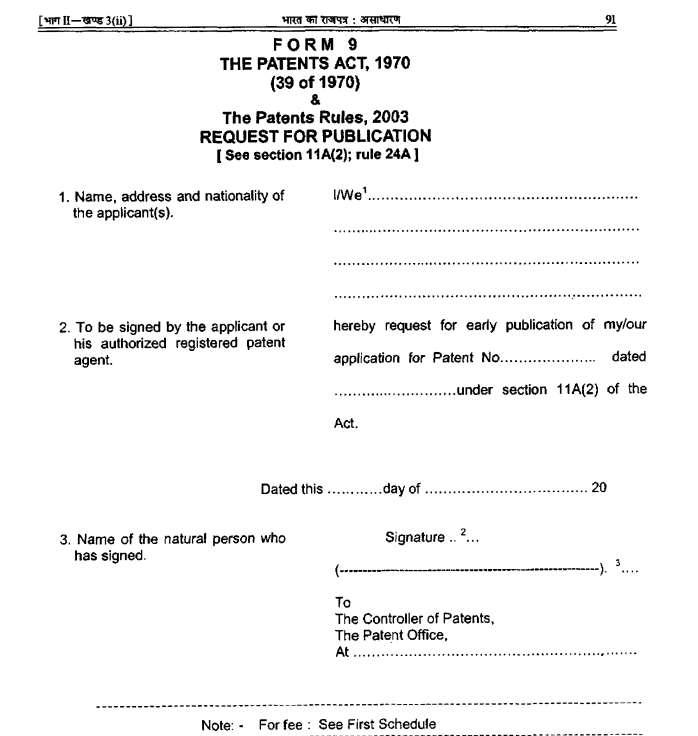
However, Section 11A(2) allows applicants to voluntarily request publication before the 18-month timeline by filing Form 9 and paying the prescribed fee. Upon such a request, the Patent Office publishes the application within one month.
Section 11A(2)
The applicant may, in the prescribed manner, request the Controller to publish his application at any time before the expiry of the period prescribed under subsection (1) and subject to the provisions of sub-section (3), the Controller shall publish such application as soon as possible.
It is important to note that only complete specifications are published. Provisional applications remain confidential and are never published on their own.
Who Is Eligible for Early Publication?
In India, any applicant with a filed patent application is eligible to request early publication, provided that:
- the application has not been withdrawn, and
- the application is not subject to secrecy directions under the Patents Act.
There is no requirement to wait for examination or any specific stage beyond filing the complete specification.
Why Applicants Choose Early Publication
Early publication is often a strategic move rather than a procedural one.
For startups and technology-driven businesses, early publication helps signal innovation readiness to investors, collaborators, and licensees. Instead of merely quoting an application number, applicants can showcase the full technical disclosure.
From a legal standpoint, publication activates the applicant’s right to claim reasonable compensation for unauthorized use occurring after publication, once the patent is granted. While infringement suits cannot be filed before grant, early publication effectively places competitors on notice.

Example:
A med-tech company planning licensing negotiations may opt for early publication to strengthen its negotiating position during due diligence.
Additionally, early publication shortens timelines for examination, since the Patent Office typically forwards applications to examiners after publication and receipt of the examination request.
Risks and Limitations to Consider
The biggest drawback of early publication is irreversible disclosure. Once published, the invention enters the public domain in terms of knowledge even if the application is later abandoned or refused.
Under normal circumstances, applicants can withdraw their application before publication to preserve confidentiality. This option is lost once early publication is requested.
Early publication also opens the door to pre-grant opposition sooner, giving third parties more time to challenge the application before grant.
Finally, despite publication-related benefits, applicants still cannot initiate infringement proceedings until the patent is formally granted.
Form 9
Conclusion
Early publication can be helpful when you want speed, visibility, or early commercial discussions. But since it permanently discloses your invention, it should be chosen carefully. The right decision depends on how ready your invention is and what you want to achieve from your patent.
















0 Comments